

By Steven A. Schumacher, CPA, ASA, Stuart T. McCallum, and Joseph A. Magyar, CPA

Steven Schumacher
Owners of dealerships organized as C corporations typically encounter some discouraging tax implications when they explore the possibility of selling. Various tax, legal, and financial implications drive the vast majority of dealership sale transactions into asset sale structures. Few buyers are going to consider a stock purchase without a considerable discount and perhaps even extensive due diligence and significant indemnifications. On the seller’s side, asset deals for C-corp dealerships trigger substantial tax bills that can eat up more than half of the sale proceeds. Fortunately, viable tax-cutting strategies are available for owners of dealerships organized as C-corps.
Tax Implications of a Sale
Dealership sales often are structured as asset deals rather than stock deals because the buyer does not want to inherit any potential liability or litigation risks from the previous owner. From a tax perspective, buyers often want a step-up in the basis of the seller’s assets. With the step-up comes the ability to deduct over 15 years the intangible goodwill or blue sky value of the dealership.
In a stock deal, the company itself is sold, and the proceeds are taxed as capital gains (with a maximum federal rate of 23.8 percent, including the net investment income tax). State income taxes on the sale will increase the overall tax bill. In an asset deal, however, the buyer purchases the business’s assets from the C-corp. The sale proceeds are taxed twice, once as earnings on a corporate level (taxed as income with a maximum federal rate of 35 percent) and again as dividends on the shareholder level.
The dealership transaction market currently is very active, and values are high. Dealership profits the past few years have been strong, with multiples trending near all-time highs for many franchises. The dealer base is aging, however, so the timing might be ideal for a long-standing dealer without a clear successor to sell to an unrelated party.

Stuart McCallum
This often is the scenario when a dealership has been operated as a C corporation for 30 or 40 years. Most long-standing owners will have very low basis in their C corporation dealership stock, which means much of the sale proceeds will be subject to taxation.
With the double layers of taxation imposed on C-corps, the taxes likely will take a sizable bite out of the proceeds. For example, a dealer could face a marginal federal and state tax rate of approximately 40 percent on the corporate level and 28 percent on a personal level. The result could be as much as 56.8 percent of the proceeds being paid to federal and state governments.
The good news is that a tax-planning tool that takes advantage of a concept known as “personal goodwill” can help C-corp owners interested in selling soon greatly reduce their tax liability. Dealers considering a sale further down the road might have another option.
Using Personal Goodwill to Cut Taxes
Personal goodwill generally is understood as the portion of a business’s value that is attributable to the owner. In other words, when an owner’s reputation, expertise, skill, knowledge, and relationships with customers are an essential part of the dealership’s success and value, it represents personal goodwill.
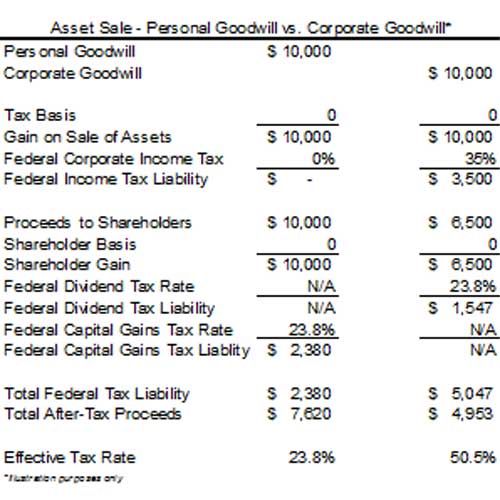
Personal goodwill can be sold separately from the dealership, with the related proceeds flowing through only the owner’s personal tax return (as a long-term capital gain), bypassing the corporate level of taxation. The potential benefits of using personal goodwill are illustrated in Exhibit 1.
This approach developed over many years based on court cases including several court rulings in the past few years. Case law legitimizes the approach and provides guidelines for using personal goodwill as a tax strategy. The right set of circumstances paired with careful consideration and implementation of the legal precedents are critical to defending personal goodwill against an IRS challenge.
Exhibit 1
Demonstrating Personal Goodwill
Of course, owners must be able to establish that personal goodwill does indeed exist in the dealership. Evidence of personal goodwill includes:
Personal branding. When consumers strongly associate a dealership with the owner, personal goodwill likely exists. That additional layer of branding, which typically includes the dealership bearing the owner’s name, strengthens the dealership’s ability to generate revenue. Personal branding might also include the owner being involved with advertising, such as being visible in television or print advertisements.

Joseph Magyar
Personal relationships. An owner’s personal relationships can bring value to a dealership. The owner doesn’t necessarily need to be out on the floor selling – perhaps he or she has a relationship with a large local business that prompts it to turn to the dealership for its fleet purchases. Similarly, an owner’s relationships with the manufacturer could result in the manufacturer granting the dealership a wide and protected market area or favorable allotments of new vehicles. Many manufacturers’ sales and service franchise agreements refer to an individual dealer by name and state that the contract constitutes a personal services agreement. This is a strong factor when supporting personal goodwill.
Personal sales. Personal involvement in sales can take the value of personal relationships up a level. An owner might actively manage the local business’s fleet purchase or personally shepherd the process for the wealthy customer who buys a new luxury vehicle every year. If the dealership has a book of business that works directly with the dealer, it’s a sign of personal goodwill.
Visionary attributes. An owner might be on the cutting edge of certain sales techniques, online marketing, or similar innovations. Think of Steve Jobs at Apple. He was well known to have his hands on everything and lead the industry in innovation.
Professional practices. Owners with high business acumen can provide significant value to a dealership by instituting efficiencies and practices that translate to positive financial statements, low employee turnover, or high customer retention. Such attributes are demonstrative of a good operator.
Absence of contractual relationship. Some recent case law provides that the existence of a non-compete or employment contract with the individual prohibits separation of personal goodwill from the corporation. Such agreements resulted in any personal goodwill being transferred to the corporation.
Following similar logic, case law indicates that either an employment agreement with a covenant not to compete or a consulting agreement with a covenant not to compete should be entered into between the seller of personal goodwill and the purchaser to represent the means by which the personal goodwill asset will be transferred to the buyer.
An Alternative Approach
Another approach is available for owners when the sale isn’t imminent – for example, when an owner expects to sell in 5 years because no family members are interested in taking over.
In those circumstances, it could be worthwhile to convert from a C corporation to an S corporation. As an S corporation, there is only one level of taxation, and capital gain rates are available. However, for a 5-year period following the S election, any gain that existed on assets owned at the time of the conversion are taxed at the corporate level, the so-called built-in gains tax. This 5-year recognition period was previously 10 years and was shortened permanently to 5 years by the Protecting Americans from Tax Hikes Act of 2015.
It’s worth noting, though, that some issues can arise from conversion, especially if the dealership applies last in, first out (LIFO) accounting for inventory. In addition to the built-in gains tax, a corporation using the LIFO method must recapture into income their entire LIFO reserve at the time of conversion. Payment of the additional tax is spread over a four-year period. Given the complexity of making an S election, C corporation dealerships should review all the requirements and consequences of conversion with their tax advisers.
C-Corp Owners Aren’t Stuck
Owners of C-corp dealerships shouldn’t regard sales as an impossibility or inevitable tax disaster. Options are available to help owners exit their businesses in a way that alleviates some of the tax burden.
Crowe Horwath is a global public accounting, technology, and consulting firm.
Steve Schumacher is a partner with Crowe Horwath LLP and can be reached at +1 630 586 5260 or steve.schumacher@crowehorwath.com.
Stuart McCallum is with Crowe and can be reached at +1 630 706 2093 or stuart.mccallum@crowehorwath.com.
Joe Magyar is a partner with Crowe and can be reached at + 1 813 209 2435 or joe.magyar@crowehorwath.com.


