


By Alysha Webb, Editor and Publisher
LAS VEGAS — Dealers are partners with the manufacturer in Ford’s Smart Mobility push, Ford Motor Co. president and CEO Mark Fields tells Automotive Buy Sell Report after the Ford press conference at CES 2016 here in Las Vegas.

Mark Fields, Ford Motor Co. president and CEO
“We complement each other,” says Fields.
That statement is somewhat contradictory. Some portions of Ford’s program will likely result in fewer sales for dealerships because of a shrinking customer pool. But, Fields argues, other parts of the plan may mean more miles traveled.
Smart Mobility is Ford’s vision of how mobility will evolve. The automaker says the plan aims to take mobility to “the next level” in the areas of connectivity, autonomous vehicles, the customer experience, and big data. Ford launched Smart Mobility at CES in 2015 and Fields expanded on it at CES this year.
“We are completely rethinking how we approach the business” of transportation,” says Fields.
Two Smart Mobility areas have the most potential to impact dealerships: Autonomous vehicles and flexible car ownership.
Fields announced that Ford is tripling to around 30 the number of autonomous vehicles in its on-road test fleet. It will use next-generation Lidar sensors with a range of up to 200 meters produced by Velodyne to accelerate development and validation of Ford’s virtual driver software.
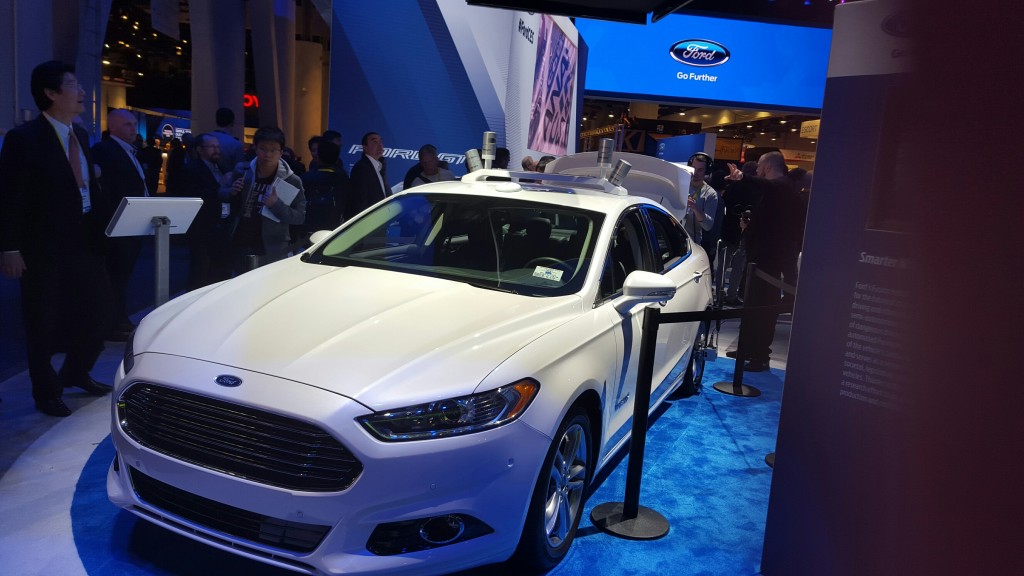
Ford Fusion Hybrid Autonomous Vehicle with new Velodyne
Although some autonomous vehicle programs may seem limited to the luxury segment, Ford’s autonomous vehicle program is designed to serve millions of drivers, says Ford.
It will also allow some segments of the population that are currently unable to drive – such as some disabled consumers – to use cars, says Fields.
Flexible car ownership is another part of Ford’s Smart Mobility plan. It is trying various car-sharing experiments in different locations around the world.
For example, in June of 2015, Ford Credit invited some 14,000 customers globally to sign up to rent their Ford Credit-financed vehicles to prescreened drivers for short-term use. In another experiment, in London, Ford offers one-way pay-per-minute trips with guaranteed parking.
Some conclusions thus far: Millennials are most interested in car sharing; most participants prefer to rent others cars rather than offer their vehicle for rental; and cars were rented an average of one time per week.
Ford is working with its dealers as it develops the Smart Mobility programs, says Fields. And while some aspects of the program may result in less demand for cars, programs such as autonomously driven vehicles may result in more miles traveled, he says. That will mean more service business for Ford’s 10,000 dealerships.
“Service is about convenience,” says Fields, and Ford’s dealerships will be the most convenient place to get the vehicles – even autonomous vehicles — serviced.
Also, while in urban areas there may be fewer cars, in rural areas there will still be plenty of consumers buying cars at dealerships, says Fields.
Fields takes care to emphasize that Ford will continue to invest heavily in designing, building, selling, and servicing vehicles, and to bring “exciting and heart-pounding” vehicles to market.
“We will continue to be a world-class innovator as an automaker,” he says.
Ford is exploring other mobility options because to not do so would mean missing out on a huge opportunity, Fields indicated.
The global auto market accounts for $2.3 trillion in revenue and Ford has six percent of that market, says Fields. The wider transportation market is worth $5.4 trillion and is growing. Ford receives virtually none of that revenue, says Fields.
Ford is “very serious about innovating in and leading in both” the auto market and the transportation market, he says.


